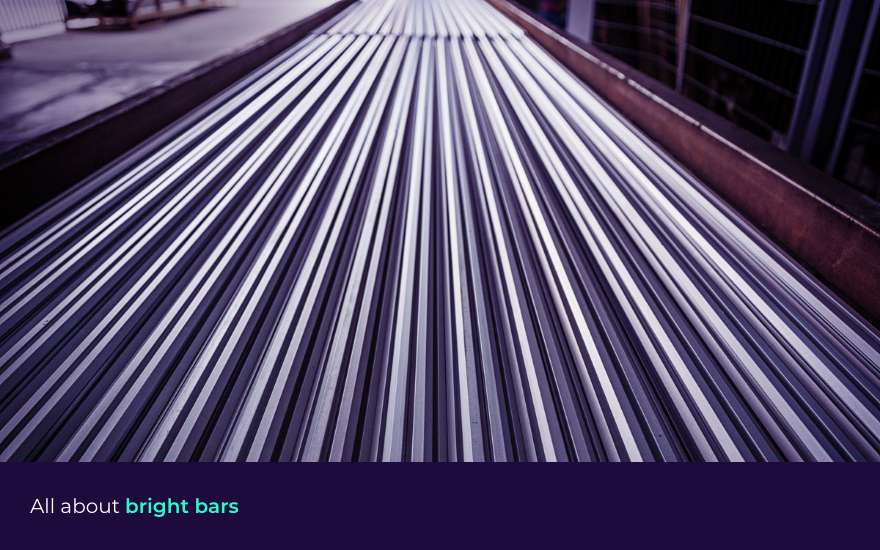
Here are typical specifications for the grade EN 8D bright bar (medium-carbon steel) used in machining / engineering applications. Use these as guideline values—actual supply sheets from mill or stockist will be authoritative.
✅ Chemical composition
According to BS 970 / stock-list data:
Carbon (C): ~ 0.40 % – 0.45 %
Silicon (Si): ~ 0.10 % – 0.40 %
Manganese (Mn): ~ 0.70 % – 0.90 %
Phosphorus (P): max ~ 0.050 %
Sulfur (S): max ~ 0.050 %
Iron (Fe): balance.
Mechanical properties (approximate)
Depending on condition (bright, cold drawn, annealed, etc) you’ll see variations. Some typical values:
Tensile strength: ≥ ~ 550 MPa (various sources)
Yield strength (or 0.2 % proof): ≥ ~ 280 MPa
Elongation: ~ 16 % minimum in some conditions
Hardness (Brinell): approx ~152–207 HB for untreated condition in one table.
Other sources for bright bar condition state:
Tensile strength range ~600–850 MPa; yield around ~400 MPa; hardness ~180–220 HB.
For supplier list: Tensile ≥ 380 MPa, Yield ≥ 210 MPa.
---
🛠 Typical forms & sizes
Bright bar: usually cold drawn, turned, peeled, polished to give better surface finish and tighter tolerances.
Size range: e.g., rounds from ~17 mm up to ~63.5 mm diameter in some listings.
Straightness and tolerance will depend on finish—e.g., some specs: straightness ≤ 1 mm per metre.
---
🎯 Applications & why use EN 8D bright bar
Because EN 8D has higher carbon & manganese than mild/low carbon steels, it offers:
Better strength & wear resistance compared to mild steels.
Good machinability in the bright (cold finished) condition, and usable for components requiring accurate dimensions.
Common uses: shafts, axles, studs, machine parts, gears, flanges under moderate load.
Things to check / specify
The exact finish: bright bar, cold drawn, peeled, turned — each finish affects tolerances and cost.
The condition: annealed, normalized, or as-drawn. Mechanical properties vary accordingly.
The tolerance class for diameter/roundness, straightness, surface finish.
Whether you need the material in “bright bar” (cold finished) vs hot rolled black bar.
For heat-treating: if the component will be quenched & tempered, make sure the grade is suited and the size allows desired properties.
Ensure the supplier material test certificate confirms chemical & mechanical properties.